SynOcu™ Cornea-on-Chip
Human-Relevant Model for Corneal Drug Transport, Safety & Efficacy Under Physiological Flow

Human-Relevant Model for Corneal Drug Transport, Safety & Efficacy Under Physiological Flow
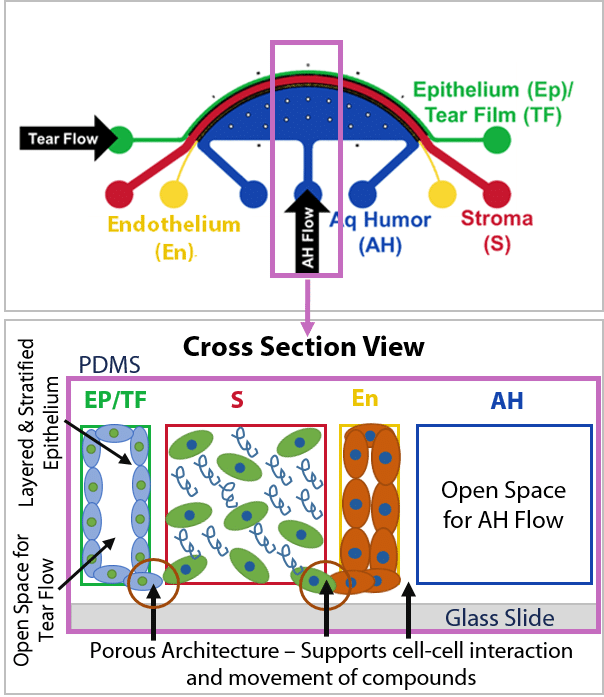
SynOcu Cornea-on-a-Chip
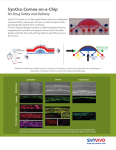
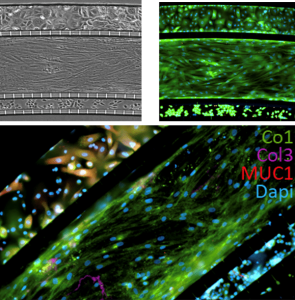
SynOcu™ is a dynamic, microfluidic Cornea-on-Chip platform designed to mimic native human corneal architecture and barrier function. Using physiologically realistic flow, SynOcu enables direct, real-time visualization of drug transport across the corneal layers—making it ideal for ophthalmic drug development, delivery optimization, and safety studies.
Key Features:
Applications:
Why SynOcu™ Outperforms Traditional Models
Performance That Mirrors Human Physiology
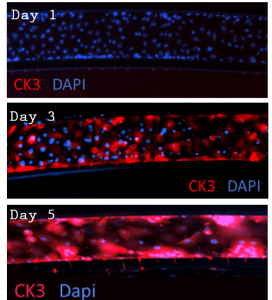
CK3 stratification marker increases under flow supporting epithelial maturation.
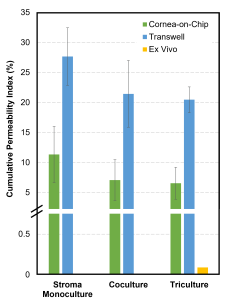
Small molecule permeability significantly decreases from mono- to tri-culture, mimicking in vivo tight junctions.
SynOcu’s flow-based model more closely mimics paracellular transport in human tissue than static Transwell inserts.

Contact our scientists to find out how SynOcu™ can accelerate your drug development with human-relevant data.
SynOcu™ Cornea-on-Chip: Comprehensive Services for Ocular Drug Development
SynVivo offers expert-led contract research services (CRO) leveraging the SynOcu™ platform for advanced ocular drug development. Our team supports end-to-end study design, execution, and analysis to meet your safety, efficacy, and delivery objectives without the limitations of animal models.
Important Note: Starter kit does not include required consumables such as cells, media, and matrix. Other required equipment not included is syringe pumps, cell seeding pumps, incubators, and microscopes.
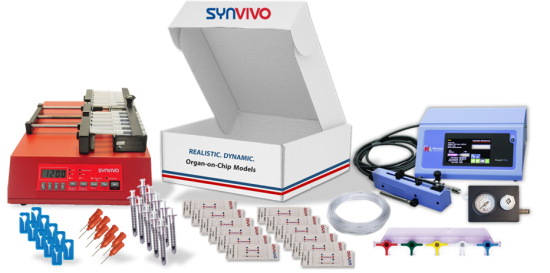
SynOcu™ Starter Kit: Start your cornea-on-chip research with ease using the SynOcu™ Starter Kit.
Includes:
The Cornea Model kit features a disposable, optically transparent chip that supports studies of trans-corneal transport under physiological flow conditions
Chip Model | CAT# | Product Name | Price | Qty | |
|---|---|---|---|---|---|
 | 501000 | $3,650 | Max: Min: 1 Step: 1 |
SynOcu™ Chip Option: The chip architecture best suits your cornea application:
The cornea chip modular design recreates 3D human-relevant trans-corneal transport conditions under physiological flow, delivering real-time quantitative analysis .
Chip Model | CAT# | Product Name | Price | Qty | |
|---|---|---|---|---|---|
| 109001-SO3 | $690 | Max: Min: 1 Step: 1 |
Training Workshops: Accelerate proficiency with SynVivo’s expert-led programs:
CAT# | Product Name | Price | Qty | |
|---|---|---|---|---|
SYN48 | SynVivo On-Site (Huntsville) Training Workshop – 2 days | $2,750 | Max: Min: 1 Step: 1 | |
SYN96 | SynVivo On-Site (Huntsville) Training Workshop – 4 days | $4,500 | Max: Min: 1 Step: 1 |
Instrumentation: Ensure high-quality results with SynVivo-compatible tools:
Image | CAT# | Product Name | Price | Qty | |
|---|---|---|---|---|---|
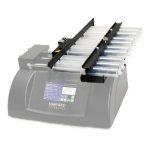 | 301004 | PHD Ultra 6/10 Multi Syringe Rack | $948 | Max: Min: 1 Step: 1 | |
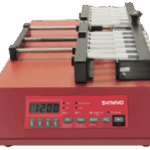 | 301020 | Multichannel Programmable Syringe Pump – SynVivo NE 1200 | $2,175 | Max: Min: 1 Step: 1 | |
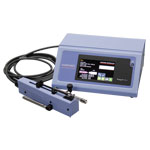 | 301002 | Pump 11 Elite Nanomite Infusion/Withdrawal Programmable Single Syringe | $3,790 | Max: Min: 1 Step: 1 | |
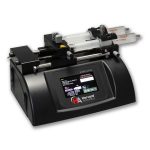 | 301003 | PHD Ultra Syringe Pump Programmable 2-Syringe Rack Standard Pressure | $5,651 | Max: Min: 1 Step: 1 |
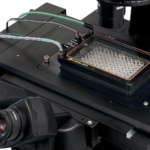
The Tokai Hit incubator offers precision temperature, humidity and CO2 control for long term cell culture on any microscope and optimal conditions for SynVivo’s microfluidic devices.
Image | CAT# | Product Name | Contact Us |
|---|---|---|---|
 | 303015 | ||
| 303016 | ||
| 303017 |